
It all began in 2011 with the idea and concept of "Quartier Zukunft – Labor Stadt" by Oliver Parodi. Science and society are looking for, testing and researching together how a culture of sustainability can be created and lived in an urban quarter.
Trying out the good life of the future.
"Quartier Zukunft – Labor Stadt" is a real-world lab of the Karlsruhe Institute of Technology (KIT) that aims to make an entire urban district and its people fit for the future. The question is: How can we live well in the city today and tomorrow – while respecting the environment and posterity? The aim is not to rebuild what already exists on a large scale, but to carefully transform it in cooperation with citizens, science, politics and the private sector.
Bringing pioneering ideas into play.
Sustainable urban development, one of the most pressing challenges of the 21st century, is being advanced with creative strategies: forward-looking pioneering ideas are being tested, developed and tried out, alternative lifestyles are being scrutinized, technical and social innovations are being brought into play.
A vibrant culture of sustainability.
While many people think primarily of sacrifice or efficiency when it comes to sustainability, Quartier Zukunft – Labor Stadt is about creating new qualities of life for the people in the neighborhood: the city is tapped into and encouraged to develop a culture of sustainability that comes into people's lives in the way they feel, think and act. The basis for this is an understanding of sustainability that places global, intergenerational justice at the center of action.
The doers? All of them.
The future has to do with us and concerns us. That's why urban development is happening in Karlsruhe's Oststadt district. The force that moves the whole thing is the participation of the urban community. Quartier Zukunft – Labor Stadt functions as a creative platform, a space for experimentation and a springboard for a variety of projects with a sustainability aspect. The real agents of change are therefore the people of Karlsruhe themselves, their associations, companies, schools and initiatives, each with their very own project ideas. Everyone is invited to join in.
Urban society meets KIT meets urban society.
The interaction of science and urban society, of scientific and practical knowledge, increases people's scope for action: KIT opens up to the region, making its knowledge useful and tangible for the neighborhood. And the citizens, as a team of experts for local tasks, carry decisive impulses from life into the institution.
Everything has to do with each other.
The Quartier Zukunft scientific team coordinates and moderates the sustainability work in the neighborhood and provides research support. It looks at the entirety of urban life as it is experienced by the residents of the neighborhood on a daily basis: Areas such as business and consumption, work, education and nutrition are viewed as interwoven and dealt with in an integrative manner. Everything is connected, everything is important. Discipline-specific thinking is broken down and replaced by transdisciplinary methods: environmental scientists consult with eastern city dwellers, urban planning experts sit at the same table as migration researchers, sociologists discuss with mobility experts. In this way, new, potentially sustainable ideas for different areas of life are brought into contact with each other in one place. And as sustainability in the neighbourhood gradually becomes more tightly woven, threads can be passed, conflicting goals identified and solutions found.
Sustainability to imitate. Quartier Zukunft as a European model.
It is assumed that around two thirds of the world's population will be living in cities by 2050. It therefore makes sense to try out sustainability right here, in the urban space. As a typical European neighborhood that has grown over time, Karlsruhe's Oststadt can serve as a model for other urban living spaces in Europe. The diversity and complexity of coexistence in the district is the real ace up its sleeve: In terms of urban planning and space, there are very different structures, people from a wide variety of backgrounds and lifestyles come together and socialize. Karlsruhe's Oststadt becomes a dense microcosm that makes complex relationships and big questions workable on a small scale.
An integrative concept of sustainable development from Karlsruhe.
Quartier Zukunft – Labor Stadt takes sustainable development seriously as a guiding principle developed by the United Nations. The starting point of the project is the integrative concept of sustainable development, a scientific and ethical concept developed by the Helmholtz Association at the Institute for Technology Assessment and Systems Analysis (ITAS) in Karlsruhe. It takes equal account of present and future generations and links thinking in global contexts with local action. The main objectives are to secure human existence and a basic supply for all people, to maintain society's potential to produce products and services and to preserve the development and action possibilities of people and societies. Ultimately, each society must decide for itself how it wants to shape sustainable development.
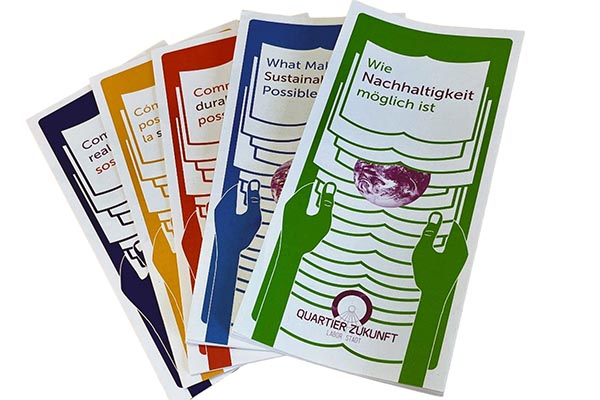
"What Makes Sustainability Possible" – Fold-out brochure available in multiple languages. Learn more
The urban space is diverse. And so are the themes in Quartier Zukunft – Labor Stadt.
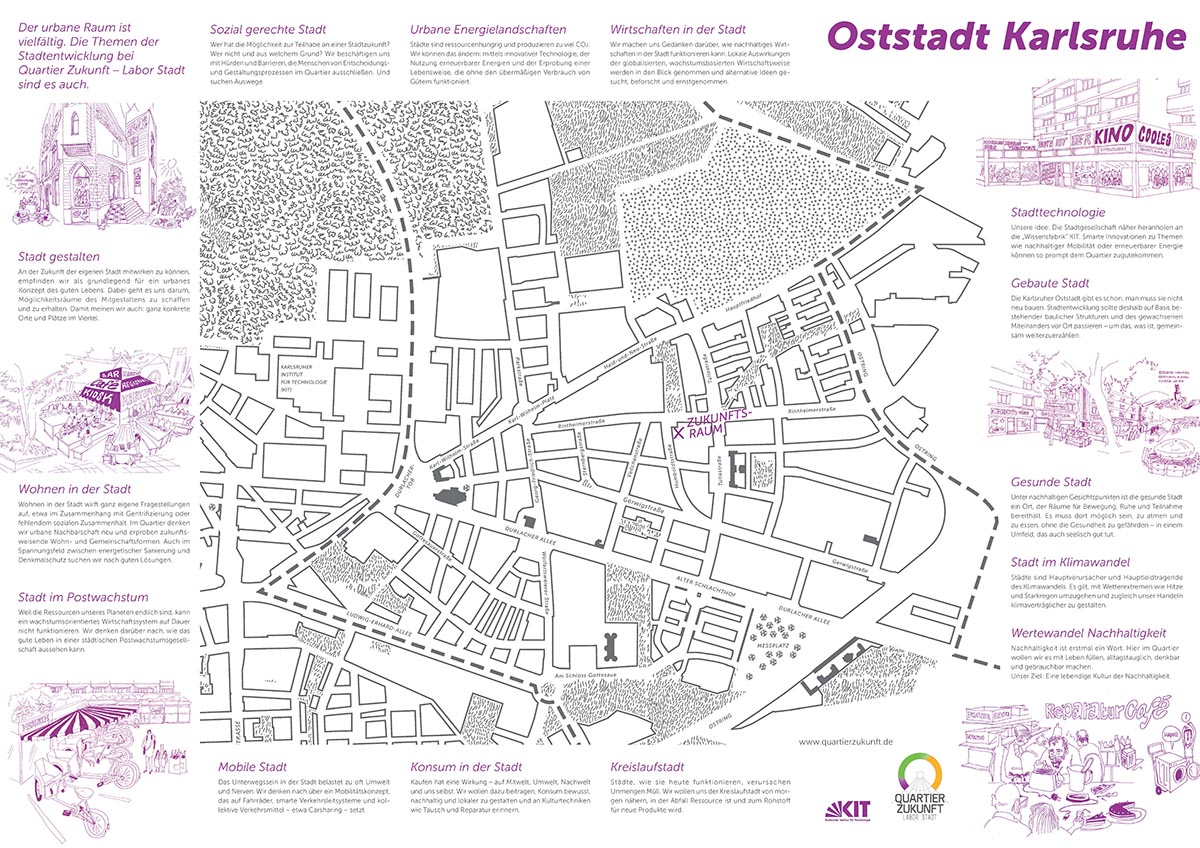
Individual areas of urban life are considered in context and dealt with in the context of sustainable development. Quartier Zukunft pursues sustainable urban development in the following areas: